Paulo Esteireiro
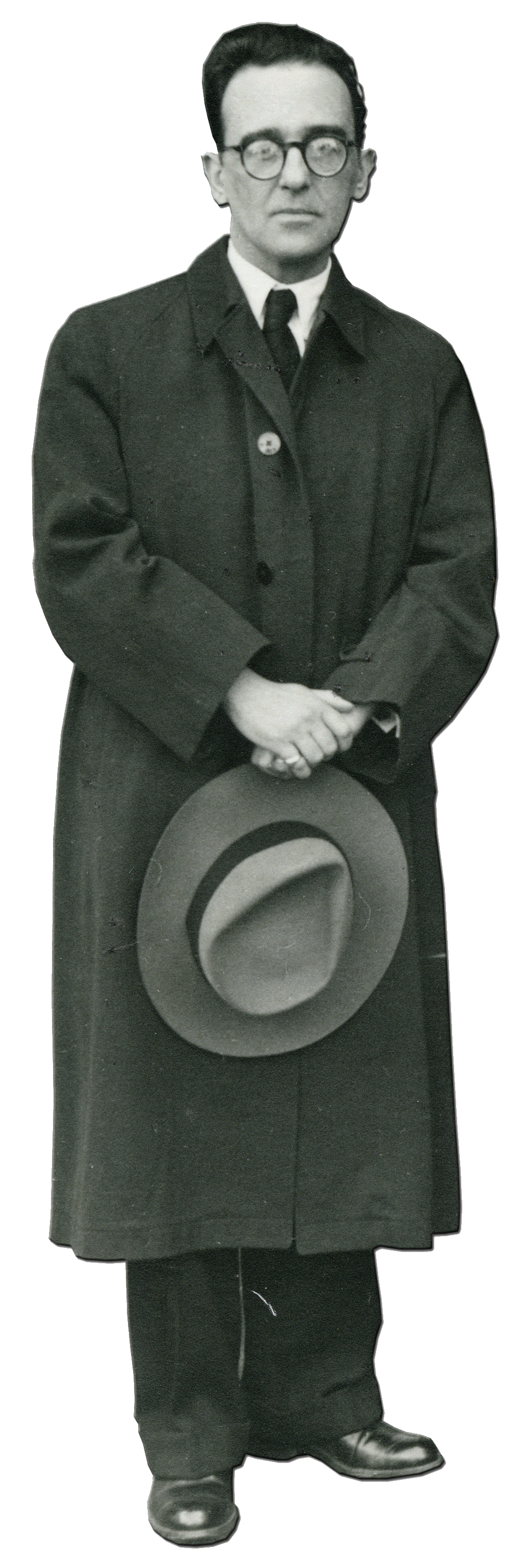
 Luiz Peter Clode was born in Funchal on April 1st 1904. After he finished with distinction at the Funchal College, he went to Coimbra in 1921, where he took a degree in Mathematics. Later he moved to the University of Oporto, where he graduated in Mechanical and Electrical Engineering in 1930. In parallel with these studies, Luiz Peter Clode always cultivated a likeness for music. Still in Funchal, he studied piano with the teachers Cora Alice Cunha and Olga da Cunha e Freitas, having continued connected to music during his University years, through the composition of various musical works and participation in the ‘Orfeão Académico’ and the ‘Tuna Académica of the University of Coimbra’. In 1931, he returned finally to Madeira as a consultant at Corys Madeira Company and later Engineer-Director of Industrial, Electrical and Traffic Services of the former General Board (among other functions) until retirement in 1974. In addition to his activity in the area of engineering, Luiz Peter Clode never abandoned his passion for music. According to his daughter Inês Clode Freitas “Over his entire life [...], the music was the apple of his eyes, and every day he played out on the piano the joys and bitterness, disappointments and hopes of an entire life devoted to family, work and culture.” Thus, it is not surprising that in the early 40’s, Luiz Peter Clode sought to organize, along with his brother William Clode, a Concert Society, within which came the ‘Academia de Música da Madeira’, school of arts which is the ancestor of the current conservatory. The ‘Sociedade de Concertos da Madeira’ (SCM) was founded in 1943, with the aim of promoting "musical art" in Madeira for the culture of "an elite society." For that purpose, the SCM would organize concerts, conferences, art festivals, which integrated Madeiran and Portuguese artists of recognized merit. Despite being elitist, the Society held the door open for popular concerts, defending to a certain point, that the concerts could be promoted for the general public, with artists employed by the SCM. For example, the current "Auditorium" of the Municipal Garden (Funchal) was inaugurated with a show by the ‘Orquestra de Concertos da Emissora Nacional’, a concert organized by the SCM assisted of thousands of people. The popular outdoor concerts were also held in various places in Funchal. Usually included in the Music Festivals of Madeira, also responsibility of SCM, these concerts were organized in areas such as Quinta Magnólia and Largo do Município. In these performances there sometimes figured works by Luiz Peter Clode, played by some of the prominent musicians to have passed through the Society. Among the most important works of Engineer-Musician, there are three pieces for piano - "Canção de Amor", "Fantasia N.º 1", and "Fantasia N.º 2",and a religious piece
  "Tantum Ergo" for two voices and organ. These four works were also printed. In October of 1945, within the SCM, the Clode brothers propose the creation of a Music Academy, to take advantage of the many musical talents. A year later, the proposal came true and the ‘Academia de Música da Madeira’ is officially inaugurated on November 13th 1946. As for the curriculum, the Academy followed, since its foundation, the model of the National Conservatory. This alignment with the programs of the Conservatory in Lisbon later earned the students of the Music Academy, the legal recognition of their qualifications at the national level, situation which still remains. The ‘Academia de Música da Madeira’ lasted 28 years, roughly, with this designation (although it came to be called Academia de Música, Belas-Artes e Línguas da Madeira). However, as the historian José Vieira Gomes refers well "ultimately, the two new educational institutions that followed with the names ‘Conservatório de Música da Madeira’ and ‘Instituto de Artes Plásticas’ were not more than the old establishment that has existed for 28 years”.